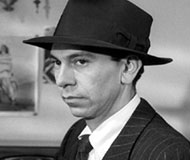
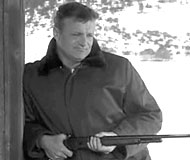
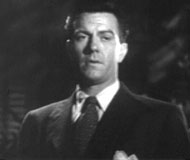
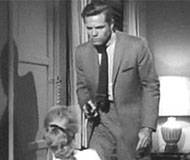
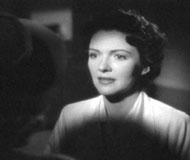
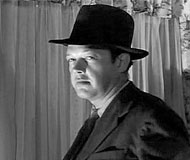
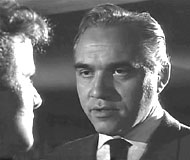
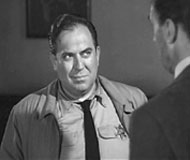
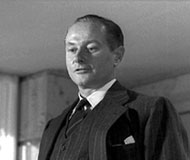
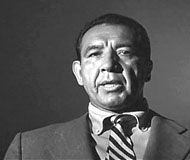
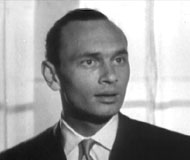
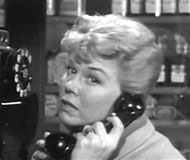
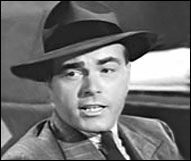
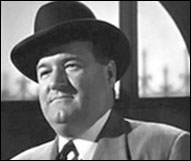
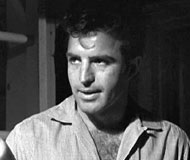
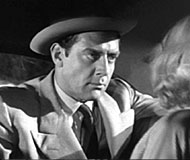
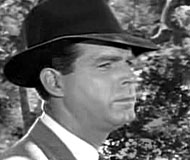
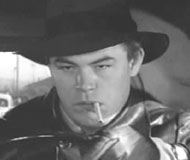
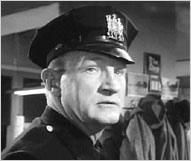
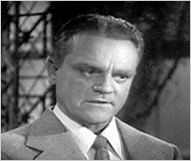
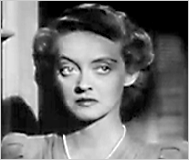
Marc Lawrence, James Flavin and Barry Kelley looked like characters out of central casting, and that’s exactly where they came
from. They were among film noir’s most prolific character actors.
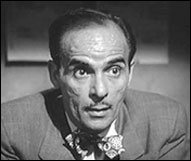
Need a gangster or thug, get Marc Lawrence was the call. In a career that spanned 70 years Lawrence appeared in 181 films,
usually as a hoodlum of some sort. While most of his roles were small, he certainly had the ability to play more substantial
parts. The best of these would be in The Asphalt Jungle where he played Cobby, the smalltime bookie and fixer. Lawrence
even appeared in two James Bond films as what else but a gangster.
What Lawrence was to gangster roles, Flavin was to cop roles. Flavin appeared in 384 feature films, invariably as a cop, be it
uniform or detective. Like Lawrence, most of Flavin's parts were small, but he too could carry himself in more substantial roles.
Such was the case in his co-
While he did not appear as often as Lawrence or Flavin, Barry Kelley was certainly film noir’s most versatile character actor.
Kelley played judges, crooks. prosecutors, politicians, shyster lawyers and cops
-

For all their collective work, Lawrence and Flavin appeared in only two films together but never shared a scene. Kelley
appeared in several films with Lawrence including The Asphalt Jungle where in one lengthy scene just between the two of them,
they showed just how good of actors they were.

Every genre has its definitive actors, those who are associated by their persona or simply by the number of films in which they appear. In that regard, film noir is not much different. Humphrey Bogart, Robert Mitchum, Glenn Ford and Robert Ryan easily come to mind when discussing film noir. Not only did each have a lengthy resume in noir, they also developed the unique persona of the genre. But there are plenty of contradictions and misconceptions. One unique aspect of film noir is that it encompassed a defined period of time in which the evolution of the genre and the influence it played in actors careers can be traced.
Many film noirs of the 1940s tended to be “A” list offerings. As such, the actors who played in them were usually known commodities drawn from the studio’s contract roles. But it was also a time when film noir played a defining role in the careers of many fledgling actors. It’s remarkable the number of actors whose careers were launched in film noir and went on to became major film stars. The first Hollywood film appearances of Burt Lancaster, Kirk Douglas, Richard Widmark, Yul Brynner and Charlton Heston were in film noir. Glenn Ford, Ava Gardner, Alan Ladd and Rita Hayworth had breakthrough roles in film noir after struggling in Hollywood. For Hayworth and Ford it would come in the noir, Gilda. Fred MacMurray, ostensibly known for romantic comedies, was salient playing dark characters in multiple noirs. While James Cagney, king of Warner Bros. Gangsters of the 30s, was not much of a factor in film noir. Lancaster, Douglas and Heston would come to define the virile leading men of their generation but in film noir they portrayed rather weak individuals, easily influenced by women. Such are the nuances you find in the genre.
Of course an actor’s studio affiliation had as much to do with their exposure to
film noir as anything other factor. But that tended to change by the early 1950s
as the studios cut cost and production. Film noir became increasingly the province
of low budget B-


Four All-
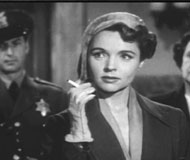
For actresses, film noir offered limited roles. Playing a strong women in noir usually meant you were a femme fatale or worse yet, a murderer. Against that would be the dames, broads and just plain losers. On the other hand there was no prerequisite for beauty for noir roles as this was a genre about hard reality, for the most part devoid of glamour. You are more apt to find beauty in the bimbo girlfriends of mobsters than anywhere else in noir. Howard Hughes put Jane Russell in three noirs when he owned RKO. The films are good, but not because of Russell who was nothing more than eye candy. On the other hand, a very plain looking Cathy O’Donnell had featured roles in six noirs. She played the type of women you would expect to find in real life noir circumstances.
Still, there were opportunities for beauties like Rita Hayworth and Ava Gardner to
have substantial roles. But for the most part it was rather average looking women
like Nina Foch, Gloria Graham, Evelyn Keyes, and Audrey Totter that defined noir.
They had a sultry allure that proclaimed their vulnerability -
The women who chose to play in film noir were able to make their mark even if there was a lack of peer recognition. Playing a femme fatale in noir provided an opportunity to make an impression that resonated with audiences. Even though she had been long forgotten, Ann Savage’s obituary was widely reported because of the impact she made with her performance as a femme fatale in Detour. Similarly Jane Greer left an indelible screen image as Kathie Moffat in Out Of The Past notwithstanding an otherwise undistinguished career. Barbara Stanwyck was one of the only top actresses who played in noir for most of its duration and was credible. Joan Crawford won an Academy Award for her performance in Mildred Pierce (a marginal noir) but miscast in later film noir roles. And Betty Davis, the tough dame you would expect to be perfect for film noir was a no show in genre.
What film noir lacked in star power it made up with a roster of character actors.
Few people would recognize them by name but the bit parts and occasionally featured
roles they played were a crucial element in creating the the atmosphere that was
unique to film noir. The reoccurring appearance of so many gives the impression
of a repertory company at work but it was an aspect that con-
By the late 50s as film noir faded, most of these actors found steady work in television while many former “A” list actors lacked for work as the studio system evolved.


As the studio system was changing in the 1950s, actors who no longer were considered stars found work in film noir. These actresses who had been leading ladies in comedies and musicals of the 30s and 40s now found themselves in the unglamorous world of noir.

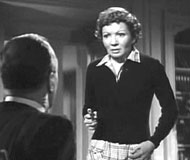
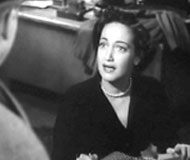
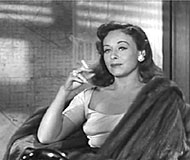
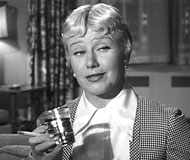
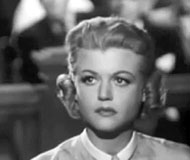
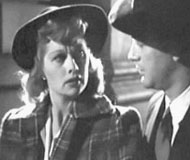
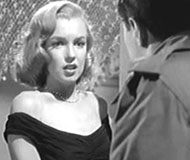
A number of actors who appeared in film noir became well known for other things. Lucille Ball became the icon of comedy but in the Dark Corner she was deadly serious. Nancy Davis became Mrs. Ronald Reagan and First Lady. Jack Lord, Lorne Greene and Angela Lansbury each played killers in film noir but went on to star on television in three of that medium’s most popular shows ever. Doris Day, Marilyn Monroe and Yul Brynner became major film stars.



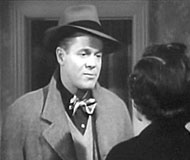
A heartless, evil person is usually at the heart of every noir story. While there
was ample violence dished out by assorted thugs and henchmen, the heavies in noir
would just as likely be a scoundrel, blackmailer or other sleazy type. And don’t
forget females could be just as deadly in noir without every pulling a trigger. Certain
actors became adept at playing people you love to hate. Unlike today's films where
the degree of violence defines the villain, in noir it was more sophisticated. While
Raymond Burr was noir’s most prolific and violent villain, other heavies dished out
their share of beatings. But violence wasn’t the only means of getting what you
wanted in noir. Extortion, double-


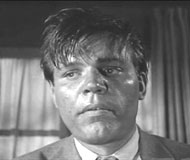
Jack Web and Vince Edwards each played serious bad guys in film noir. Yet they went on to star in popular television shows playing
esteemed characters. In a bit of irony, Webb murders his future Dragnet partner, Harry Morgan in 1951’s Appointment With Danger. Before saving lives as Doctor Ben Casey, Edwards was taking them, playing vicious killers in three noirs.